
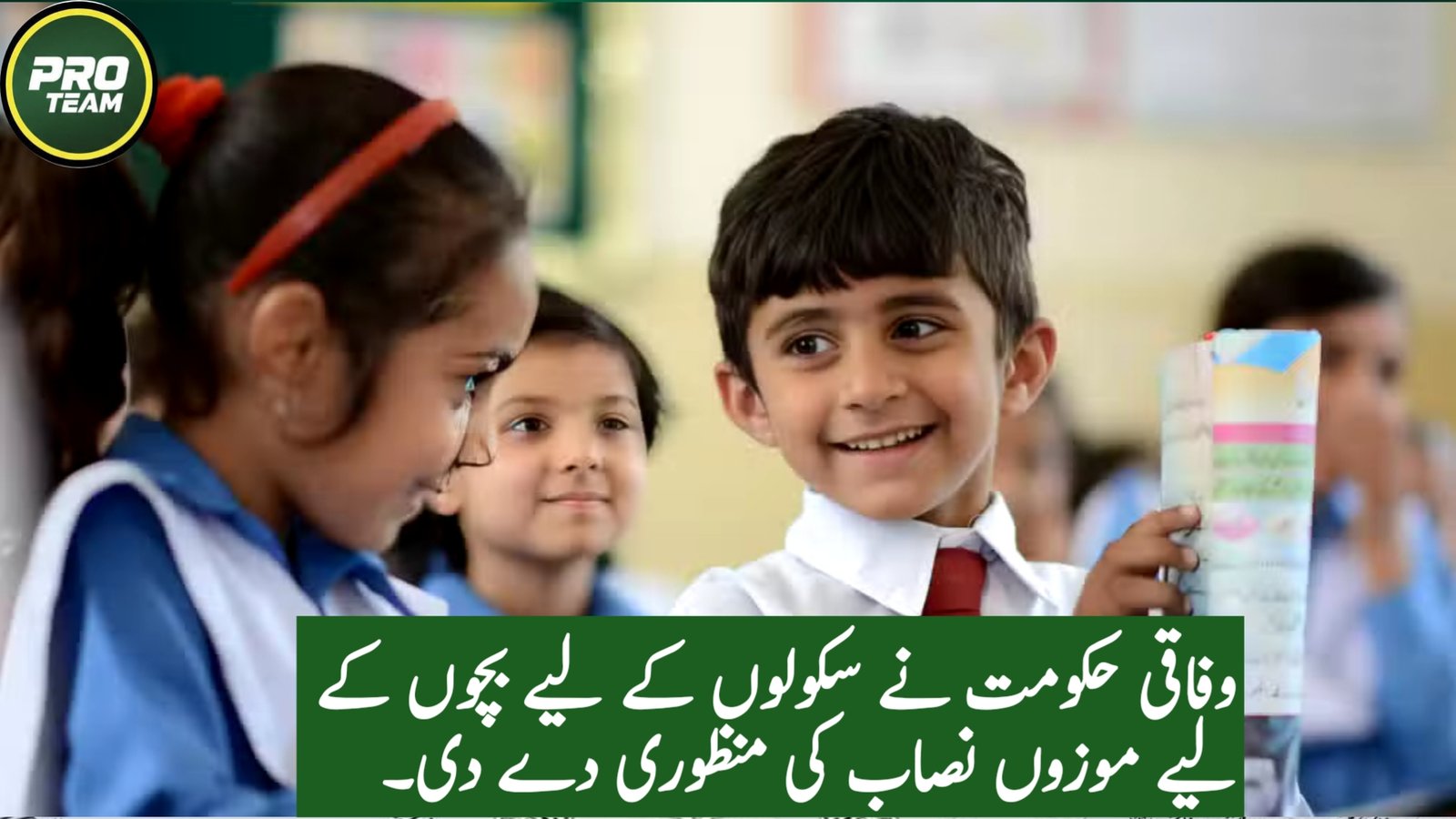
The Federal Government of Pakistan has approved a new child-friendly syllabus under the National Curriculum to reduce academic pressure on young students, especially from nursery to Grade 2, and make learning more engaging and practical. The revised framework focuses on activity-based learning, introduction of modern subjects like social sciences, financial literacy, and climate awareness, and aims to improve early education outcomes. Officials confirmed that the new syllabus will be implemented after final consultations in the upcoming academic session, with full coordination between federal and provincial authorities.
Detail Table
| Key Aspect | Details |
|---|---|
| Program Name | Child-Friendly National Curriculum |
| Approved By | Federal Government of Pakistan |
| Target Classes | Nursery to Grade 2 |
| Main Objective | Reduce burden & improve learning |
| New Subjects | Social Sciences, Civic Education, Financial Literacy |
| Implementation | Expected next academic session |
| Official Website | https://mofept.gov.pk |
What is the Child-Friendly Syllabus?
The new syllabus is designed to make education easier, interactive, and more understandable for young children. Instead of rote learning, students will learn through fun activities, helping them build concepts effectively and reduce mental stress in early schooling.
Why This New Curriculum Was Introduced?
Government surveys revealed that young students were facing excessive academic pressure, making learning difficult at an early stage. The new curriculum aims to address this issue by simplifying content and focusing on conceptual understanding rather than memorization.
Key Changes in the New Syllabus
- Activity-based and engaging learning methods
- Reduced number of subjects for early grades
- Introduction of civic education under social sciences
- Focus on life skills and real-world knowledge
- Balanced and simplified study structure
New Subjects and Skills Included
The updated curriculum includes modern and practical subjects such as:
- Climate change awareness
- Financial literacy
- Life safety skills
- Civic and social education
These additions aim to prepare students for real-life challenges and future responsibilities.
Implementation Plan
The Ministry plans to introduce this syllabus in the next academic year after final approval. All provinces, including AJK and Gilgit-Baltistan, are aligned with the reform to ensure nationwide implementation.
Eligibility Criteria
- Applicable to all public and private schools following the national curriculum
- Focused mainly on students from Nursery to Grade 2
- Schools must comply with government-approved curriculum guidelines
Conclusion
The approval of a child-friendly syllabus marks a major step toward improving Pakistan’s education system. By reducing academic burden and introducing practical knowledge, the government aims to create a more effective and enjoyable learning environment for young students. This reform is expected to enhance early education quality and support long-term academic success.
FAQ
Q1: When will the new syllabus be implemented?
It is expected to be introduced in the upcoming academic session after final approvals.
Q2: Which classes will benefit the most?
Students from Nursery to Grade 2 will benefit the most.
Q3: What is the main goal of this curriculum?
To reduce academic pressure and improve understanding through activity-based learning.
Q4: Will new subjects be added?
Yes, subjects like social sciences, financial literacy, and climate awareness are included.
Q5: Is this curriculum applicable across Pakistan?
Yes, it will be implemented nationwide with agreement from all provinces.